What is this game?
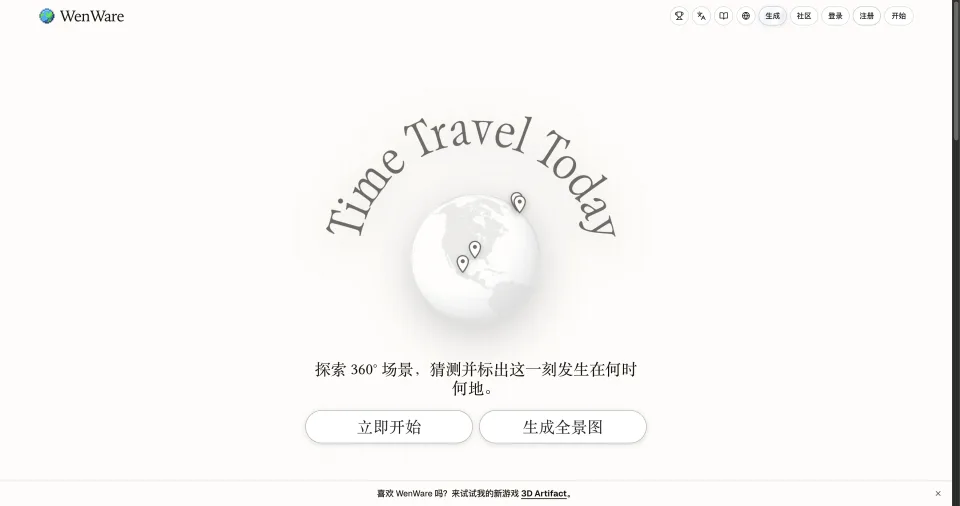
A historical geography puzzle played inside panoramic scenes. Look around for clues in architecture, clothing, objects and events, then place a pin on the world map and select the year you think fits. A round reveals the intended moment, distance error, historical error and a source card before the next scene.
Where the AI fits
WenWare began as an entry in Vibe Jam 2026, whose official rules required at least 90% AI-written code. The creator’s site names the jam and award; independent reporting identifies GPT-Image-2 for the equirectangular scenes and OpenAI Codex for much of the app code. This supports AI-assisted production and AI-generated imagery, not live model inference during a guess.
How to play: questions & first steps
How do I start playing WenWare?
Open the official homepage and choose Start Game. The observed public entry presents the 360° history premise and a direct start control; no account was created and no full round was completed for this listing.
What controls does WenWare use?
Inspect the panorama by looking around, then use the map pin and year selector to submit a spacetime guess. The official how-to-play page describes five rounds, with a result card after each answer.
What should I try first?
Look for several clues before picking a year: clothing, architecture and objects may point to different eras. Read the revealed source card after each guess; the AI panorama is a reconstruction.
Beginner suggestions based on the maker instructions and sources below; not a completed walkthrough or a guaranteed winning strategy.
Is WenWare free, and do I need an account?
The official site currently presents a public Start Game path. WenWare also advertises sign-in, plans and credits for panorama generation, so this listing does not claim that every mode or generation feature is free.
How to approach a WenWare historical panorama without guessing blindly
Editorial guide updated 2026-11-19. The timetable is a suggested practice plan, not an official round length or a completed playtest. Publisher material last checked 2026-11-11.
How to separate a scene’s date clues from its location clues
Use two separate questions when looking around a historical panorama: what could locate this scene, and what could date it? A coastline or a recognizable building can narrow the place without telling you the year. Clothing or a visible technology can suggest a period without identifying the city. Keeping those tracks separate helps prevent one vivid detail from turning into an unsupported guess about everything else.
WenWare uses generated imagery, so a convincing object is not automatically reliable historical evidence. Treat the panorama as the game’s representation of an intended moment. Look for several clues pointing in the same direction before committing. This is especially useful when a visual detail seems modern or contradictory: note the conflict, consider the larger scene and avoid claiming that an image alone proves what a real historical setting looked like.
First 15 minutes: build a repeatable observation routine
- Minutes 0–3: open the official game and read the current mode instructions. Identify the panorama controls, date input and map before making a serious guess. If a timer is active, make a quick inventory of the controls instead of spending the whole round searching for the submit button.
- Minutes 3–6: inspect a scene broadly, then focus on a few distinctive details. Separate your observations into place clues and period clues. Record a confidence range in your own notes, such as a broad region or century, rather than inventing a precise answer immediately.
- Minutes 6–10: choose the strongest supported location and date using the available controls. After the reveal, compare the intended answer with the specific clue that influenced you most. Read the source card as background on the intended event, not as proof that every rendered object is accurate.
- Minutes 10–15: carry one lesson into the next available scene. For example, inspect the environment before clothing, or establish a broad period before narrowing the year. Focus on improving the observation process rather than chasing a leaderboard position or assuming a fixed list of repeated answers.
Questions about historical accuracy and useful guesses
Should you choose an exact year immediately? Only if the scene gives you a distinctive event you can identify with reasonable confidence. Otherwise start with a period and refine it. A narrow unsupported answer can feel knowledgeable while resting on a weak clue. The game may still require a single year; make that final selection from your best estimate while remembering which parts of the reasoning were uncertain.
What if a scene contains an apparent error? Do not silently turn it into a historical fact in your notes. Generated images can mix visual signals. Compare several features, use the reveal to identify the intended event and consult the linked historical background where accessible. This directory is describing a puzzle and a method for approaching it, not certifying its panoramas as primary historical records.
Do the reported traffic and awards tell you how to solve a round? No. Those are background to the project, not gameplay evidence. The useful information is the current interface and the clues in front of you. We have not independently completed a full scored session, verified every round rule or reproduced a top score. The suggested timetable above is an editorial learning plan, not the game’s official duration.
WenWare compared with other short browser challenges
Choose WenWare when you enjoy interpreting a scene and making a geography-and-time hypothesis. Quick Draw reverses the visual relationship: you make a picture and a model interprets it. One rewards observation of an existing environment; the other rewards communicating an outline quickly. Their common AI connection does not imply the same skill or the same role for a live model.
If you prefer developing a theory through written questions, Jack & Mani gives you a case structure rather than a panorama. If you want a fictional lifetime shaped by choices, 1 in 8 Billion offers a different kind of context. Decide whether you want to infer a hidden answer or watch consequences unfold, then follow the relevant game link instead of judging entirely by an impressive scene image.
Publisher references for this guide:
Game guides
Before you open the tab
The historical panoramas are AI-generated reconstructions, not documentary photographs or primary historical records. Treat visual details as game clues and consult the linked reference article for historical context; no scoring accuracy or factual completeness is guaranteed here.
This is an editorial listing, not a gameplay test or an endorsement. Check the publisher’s current instructions and terms before providing data or paying for model usage.