The phrase “AI game” can describe a model running every turn, a developer using an AI coding assistant, or a story about a robot. Those are different experiences. Here is the distinction behind every label on this site.
01 / Ask when the AI is involved
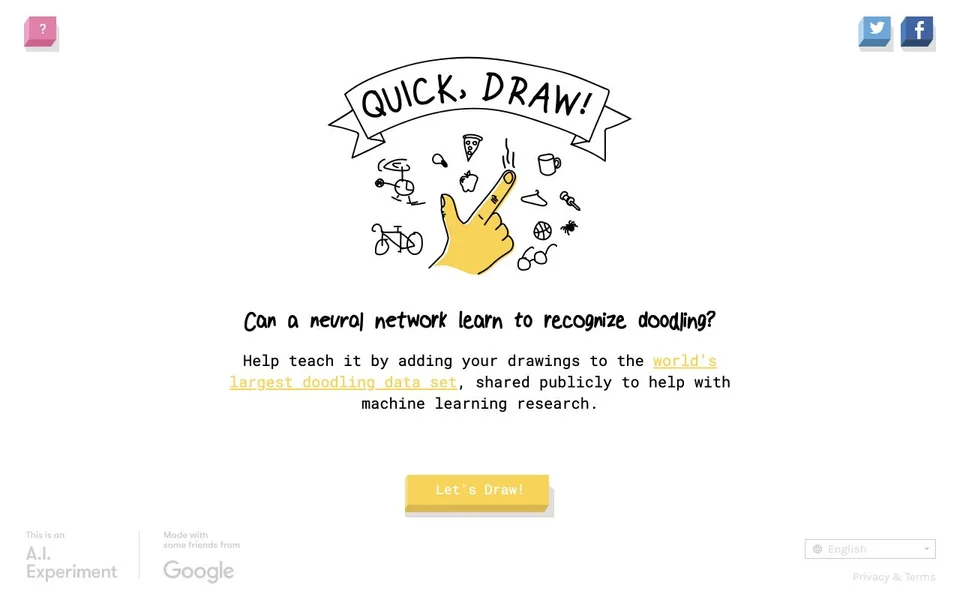
In an AI-powered game, some part of the live play depends on machine-learning inference. Quick, Draw! uses a recognizer to guess the sketch as it is made. AI Dungeon uses a model to continue the story after your action. If that live model were removed, a central part of the game would change.
An AI-assisted game can instead be a fixed build: the developer used a language model to write JavaScript, generate artwork, or iterate on level designs. That is a production method, not necessarily a runtime mechanic. TUMBLE is listed under this second label based on its creator’s tooling disclosure. A game can satisfy both descriptions, but neither implies the other.
02 / What is not enough evidence?
A title featuring robots, a character called “AI”, or a screenshot showing chat bubbles proves little. A tag on a third-party directory is also only a discovery lead. We look for a product explanation, gameplay documentation, source repository or a first-person creator announcement that describes where the AI actually participates.
Even detailed creator descriptions do not establish a successful play session today. A project may require an account, paid model calls or an API key. That is why we distinguish a source-confirmed browser entry from personally testing the end-to-end loop.
03 / A reproducible verification checklist
First, find the official play address rather than a clone or fan-site mirror. Second, find the author’s explanation of the interaction. Third, record controls, required accounts and any obvious cost boundary from the publisher. Fourth, record the check date. Finally, write the summary in your own words and keep the source link beside the listing.
Where a fact is not supported, “not verified” is more useful than guessing. The absence of a pricing notice is not proof that a game is free forever. A desktop screenshot is not proof of mobile compatibility. A launch post is not proof that a server remains operational.
04 / Why the distinction matters to players
Runtime AI may deliver novelty but also latency, inconsistent world state or usage caps. A traditionally programmed game made with an AI assistant may be more predictable, yet still interesting as an example of a small creator shipping an ambitious idea. Neither category is inherently better.
Choose for the mechanic you want: a word model you can trick, a character that improvises, an investigation driven by your questions, or a conventional arcade challenge. The label should save time, not assign prestige.
Editorial note: all references to specific games are based on the publishers’ documented features, not personal playtest claims. See each listing for its source links and access limitations.