Start from the Play now link on Kith Moot’s official website. The homepage advertises a short adventure without registration. Its saved campaign instructions use a separate sign-up flow, so “no account needed to start” should not be read as unlimited anonymous campaigns. This guide follows official documentation, not a completed adventure.
01 / Choose an introduction or a saved campaign
Try the short opening if you want to understand the format before registering. For a saved campaign, follow the game’s account flow. Read the screen you actually see: the publisher describes an immediate introduction alongside a fuller account-based setup, and their requirements should not be confused.
The campaign setup offers SRD 5.1 or SRD 5.2.1 and a ready-made character or a character-building path. For a first session, choose a ready-made hero if your main goal is learning the interface. That is a convenience suggestion, not a claim that a particular edition or character is strongest.
- Follow Play now from Kith Moot’s official homepage.
- Use the short introductory adventure to try the format before registering.
- Describe one action appropriate to the scene in front of you.
- Read the narration and any displayed check result before choosing your next move.
02 / Describe one action instead of demanding an outcome
The published interaction model is to write what your character attempts. A useful first-action example is “I examine the doorway before stepping through.” Another is “I ask the innkeeper what work is available.” These are illustrative inputs, not verified commands, guaranteed events or a puzzle solution. Adapt them to the scene in front of you.
Give yourself a clear decision after the reply. Exploring a doorway may reveal something to investigate or a reason to choose another route; talking to someone may suggest a follow-up. One concrete attempt is easier to evaluate than asking for a whole journey, several conversations and a successful fight in a single input.
03 / Read the roll before choosing your next move
When an action needs a check, the starting guide says the game shows its die, bonus and target. The publisher distinguishes the AI’s narration from the engine that tracks rules and resources. Read the result before deciding what happened; describing a successful action in your input does not make the check succeed.
Treat a failed check as a change in the situation. Our suggestion is to choose a different approach that fits the resulting story rather than repeating an identical request solely to obtain a better number. This is a general playing habit, not a guaranteed way around any encounter.
04 / Check the combat interface and your current resources
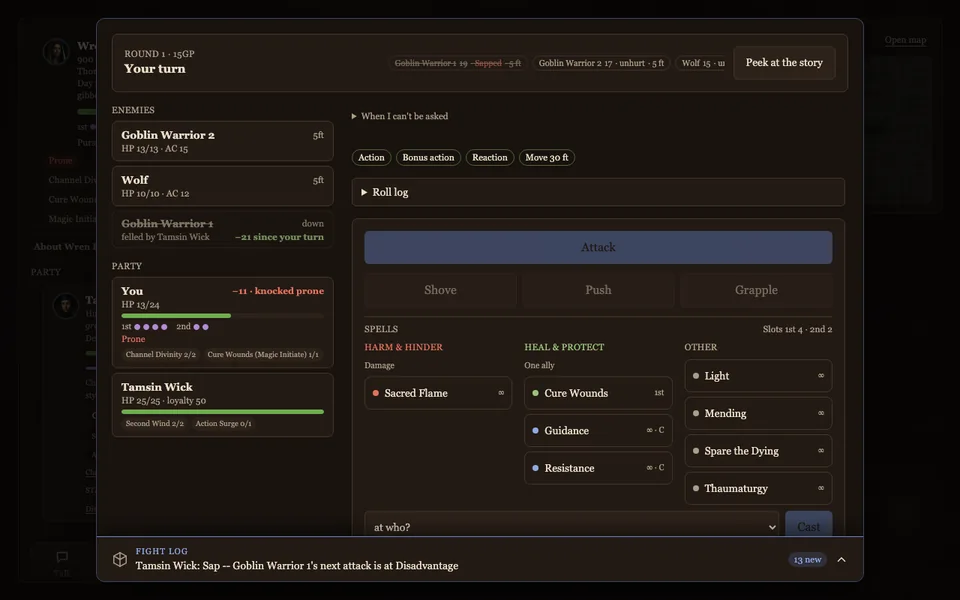
Official instructions describe a dedicated fight screen with turn order, distances, hit points and an action log. Read the available actions there before writing a long sequence of intentions. After the fight, return to the current story and decide on one next objective. Maps, inventory and the journal can help you reorient yourself.
The image accompanying this guide is a publisher-provided combat screenshot. It illustrates the fight interface; it is not a capture of our own session or proof of the account-free opening. This article does not promise a particular encounter or a winning combat sequence.
05 / How much is free, and do you need your own AI key?
The account-based Free plan currently lists 25 turns per day, capped at 300 per month, with short campaigns and campaign-count limits. This is separate from the short anonymous opening. Check current limits before planning a long session. The pricing explanation counts a storyteller reply as a turn, including conversational replies; inspecting your sheet, pack and map does not consume one.
Ordinary plans do not require your own AI key. BYOK is optional and paid, with the external AI provider billing usage separately. It is not cost-free unlimited AI. The FAQ also says free players can join a friend’s game, while hosting friends requires a paid plan. Check the linked pricing and multiplayer explanations before choosing an upgrade.
Explore these game categories
Source trail
- Official Kith Moot opening adventure and play link ↗ · Evidence checked 2026-11-11
- Official campaign setup, action and combat instructions ↗ · Evidence checked 2026-11-11
- Official free-turn limits and BYOK pricing ↗ · Evidence checked 2026-11-11
- Official rules, AI key and multiplayer answers ↗ · Evidence checked 2026-11-11
Editorial note: all references to specific games are based on the publishers’ documented features, not personal playtest claims. See each listing for its source links and access limitations.